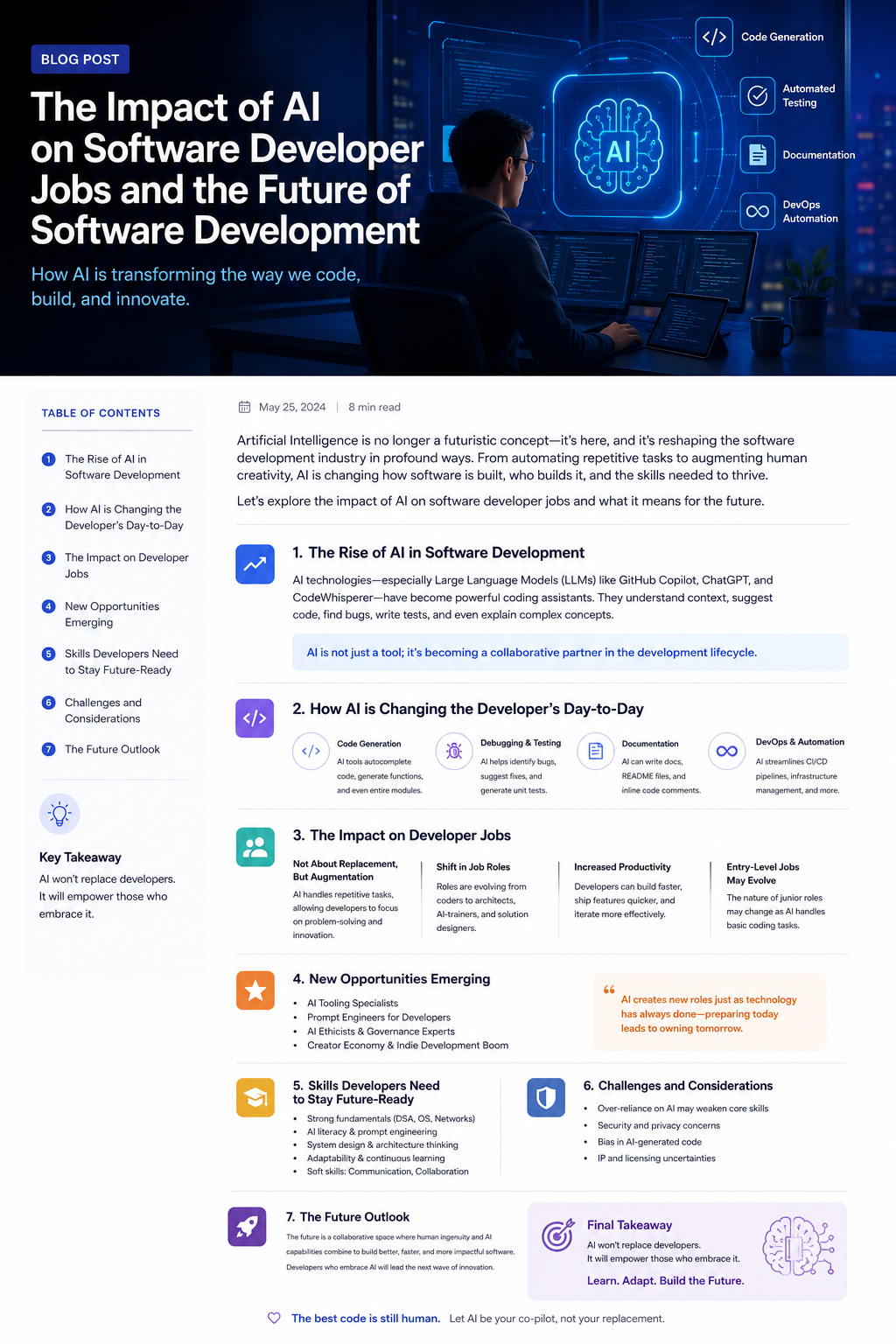
Introduction
Artificial Intelligence (AI) has rapidly evolved from a futuristic concept into a transformative force that is reshaping industries worldwide. Among the sectors experiencing the most significant disruption is software development. Tools powered by AI can now generate code, detect bugs, write documentation, create test cases, and even assist with system design.
As AI capabilities continue to advance, a common question arises:
Will AI replace software developers?
The short answer is no. However, AI is fundamentally changing how software is built, how development teams operate, and what skills developers need to remain competitive.
Rather than eliminating software developers, AI is becoming a powerful collaborator that enhances productivity, automates repetitive tasks, and enables developers to focus on higher-value work. Understanding this transformation is essential for developers, technology leaders, businesses, and students preparing for careers in software engineering.
The Rise of AI in Software Development
The software industry has always embraced automation. From compilers and frameworks to DevOps pipelines and cloud platforms, every technological advancement has aimed to make developers more productive.
AI represents the next major leap.
Modern AI-powered tools such as code assistants, automated testing platforms, and intelligent DevOps systems can understand programming patterns, suggest solutions, and accelerate development workflows.
AI systems are now capable of:
Generating code snippets
Completing functions automatically
Detecting security vulnerabilities
Writing documentation
Creating unit tests
Reviewing pull requests
Explaining complex codebases
Assisting with debugging
Optimizing application performance
These capabilities allow development teams to produce software faster than ever before.
How AI is Changing the Daily Work of Developers
1. AI-Powered Code Generation
Perhaps the most visible impact of AI is automated code generation.
Developers can describe a feature in natural language and receive working code within seconds. AI tools can generate:
Frontend components
Backend APIs
Database queries
Unit tests
Configuration files
Infrastructure scripts
This significantly reduces time spent on repetitive coding tasks.
However, generated code still requires human review. Developers must verify correctness, security, maintainability, and performance before deployment.
Impact:
Faster development cycles
Reduced boilerplate coding
Increased productivity
2. Smarter Debugging and Testing
Software testing traditionally consumes a large portion of development time.
AI can:
Predict potential bugs
Suggest fixes
Generate automated test cases
Identify edge cases
Analyze error logs
Instead of spending hours tracking down issues, developers can focus on solving complex architectural challenges.
Impact:
Improved software quality
Faster bug resolution
Reduced maintenance costs
3. Automated Documentation
Documentation is often neglected because developers prioritize feature development.
AI can automatically generate:
API documentation
Technical specifications
User guides
Release notes
Code comments
This helps maintain better project knowledge and improves collaboration between teams.
Impact:
Better communication
Easier onboarding
Improved maintainability
4. AI-Driven DevOps and Infrastructure Management
AI is transforming DevOps practices through intelligent automation.
Modern systems can:
Monitor infrastructure
Predict failures
Optimize cloud resources
Automate deployments
Detect security threats
Developers and operations teams can spend less time managing systems and more time improving products.
Impact:
Greater reliability
Lower operational costs
Faster deployments
Will AI Replace Software Developers?
This question dominates discussions across the technology industry.
The reality is more nuanced.
AI excels at:
Pattern recognition
Repetitive tasks
Code generation
Data processing
Humans excel at:
Creativity
Problem solving
Critical thinking
Product vision
User empathy
Business understanding
Software development is far more than writing code.
Developers must:
Understand user needs
Design scalable architectures
Make trade-off decisions
Ensure security and compliance
Collaborate with stakeholders
Manage complex systems
These responsibilities require human judgment and contextual understanding that AI currently cannot replicate.
The Real Shift
The future is not:
AI vs Developers
The future is:
Developers + AI
Developers who effectively leverage AI tools will outperform those who do not.
Jobs Most Affected by AI
Not all software development roles will experience the same level of disruption.
Entry-Level Coding Roles
Routine programming tasks are becoming increasingly automated.
Activities such as:
Basic CRUD applications
Simple frontend pages
Repetitive scripting
Standard API integrations
can often be generated quickly by AI.
As a result, junior developers may face higher expectations and need stronger problem-solving abilities.
Quality Assurance Engineers
AI-powered testing platforms are automating many traditional testing processes.
Manual testing roles may decline while demand increases for:
Test automation specialists
AI testing experts
Quality engineering professionals
Technical Support and Maintenance Teams
AI chatbots and automated diagnostic systems can handle many common support tasks.
However, complex technical issues will still require human expertise.
New Opportunities Created by AI
Historically, technological revolutions create new jobs even as they transform existing ones.
AI is already generating entirely new career paths.
AI Integration Engineer
Organizations need professionals who can integrate AI into existing products and workflows.
Responsibilities include:
API integrations
Workflow automation
AI system deployment
Performance optimization
Prompt Engineer
Although the role continues to evolve, organizations increasingly need experts who understand how to communicate effectively with AI systems.
Skills include:
Prompt design
Workflow engineering
Context management
AI evaluation
AI Product Manager
AI products require specialized management due to unique challenges involving:
Ethics
Accuracy
Bias
Data governance
Demand for AI-focused product leaders continues to grow.
AI Security Specialists
As AI adoption increases, organizations need experts who can secure AI systems against:
Prompt injection attacks
Data leakage
Model manipulation
Security vulnerabilities
Skills Developers Need in the AI Era
To remain valuable, developers must evolve alongside technology.
1. Strong Software Engineering Fundamentals
AI can generate code, but it cannot replace deep understanding of:
Data structures
Algorithms
Operating systems
Networking
Databases
System architecture
Fundamentals remain essential.
2. System Design and Architecture
As coding becomes easier, architectural thinking becomes more valuable.
Organizations increasingly need developers who can design:
Scalable systems
Distributed applications
Cloud-native platforms
Secure infrastructures
3. AI Literacy
Every developer should understand:
Machine learning basics
Large language models
AI limitations
AI security risks
AI integration patterns
You do not need to become an AI researcher, but understanding AI is becoming a core professional skill.
4. Problem-Solving Ability
AI can generate solutions, but identifying the right problem remains a human responsibility.
Critical thinking will become one of the most valuable skills in technology.
5. Communication and Collaboration
As technical tasks become more automated, human-centered skills gain importance.
Developers must effectively:
Communicate ideas
Collaborate across teams
Understand business goals
Translate requirements into solutions
Challenges and Risks of AI in Software Development
While AI offers tremendous benefits, it also introduces significant challenges.
Security Concerns
AI-generated code may contain:
Vulnerabilities
Insecure patterns
Compliance issues
Human review remains essential.
Over-Reliance on AI
Developers who rely entirely on AI may experience a decline in core technical skills.
Maintaining a strong understanding of software fundamentals is critical.
Intellectual Property Issues
Questions remain regarding:
Code ownership
Copyright compliance
Licensing concerns
Organizations must develop clear AI governance policies.
Bias and Accuracy Problems
AI systems occasionally produce incorrect or misleading outputs.
Developers must validate AI-generated content before deployment.
The Future of Software Development
Over the next decade, software development will likely become increasingly AI-assisted.
Future developers may spend less time writing code and more time:
Designing systems
Defining requirements
Managing AI workflows
Solving business problems
Innovating new products
Coding itself will remain important, but it will no longer be the primary differentiator.
The most successful developers will be those who combine:
Technical expertise
AI proficiency
Business understanding
Creativity
Leadership skills
AI will become a co-pilot rather than a replacement.
Conclusion
Artificial Intelligence is transforming software development faster than any previous technological advancement. It is automating repetitive tasks, increasing productivity, improving code quality, and creating entirely new opportunities.
While some traditional roles may evolve or decline, AI is unlikely to eliminate software developers altogether. Instead, it is changing what developers do and increasing the value of skills that machines cannot easily replicate.
The future belongs to developers who embrace AI, continuously learn new technologies, and focus on solving meaningful problems.
The question is no longer whether AI will impact software development.
The question is how effectively developers can adapt and thrive in an AI-powered world.
Key Takeaways
AI is transforming software development, not replacing it.
Routine coding tasks are becoming increasingly automated.
Demand for AI-skilled developers is rapidly growing.
Strong software engineering fundamentals remain essential.
System design, creativity, and problem-solving are becoming more valuable.
New AI-focused roles are emerging across the technology industry.
Developers who embrace AI will have a significant competitive advantage.
The future of software development is human-AI collaboration, not human replacement.